Human skin measurements
A percentage can sound much larger when the thing being counted slips out of the sentence.
Who made more collagen?
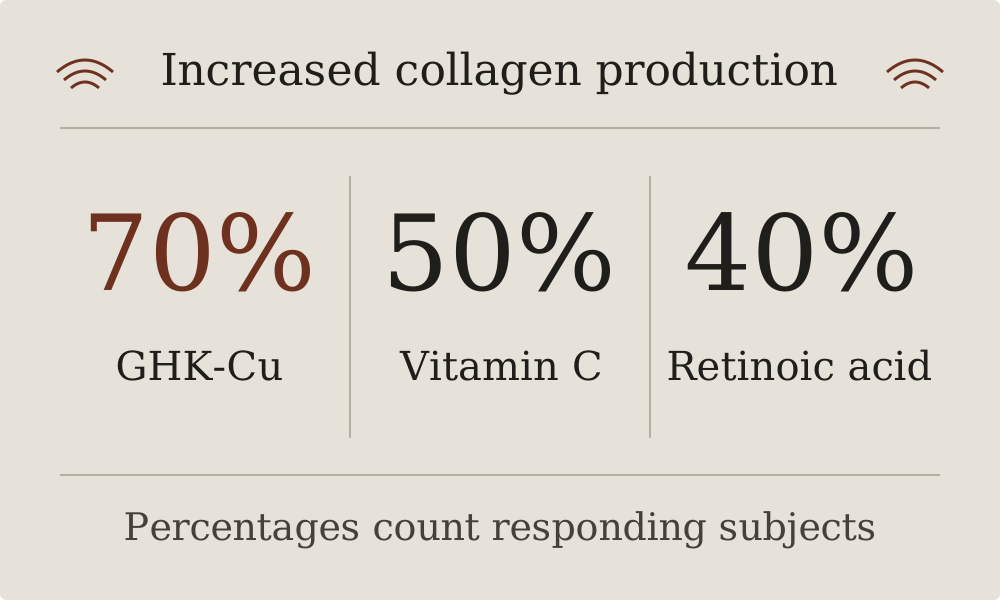
The skin-regeneration review reports increased collagen production in 70% of GHK-Cu-treated women, compared with 50% for vitamin C and 40% for retinoic acid. The anti-wrinkle review also discusses increased procollagen synthesis in 70% of GHK-Cu-treated subjects, against those comparator figures.
The percentage counts subjects with an increase. It gives no measure of how large each person’s increase was. The response being counted matters more than the apparent size of the percentage.
It also leaves a separate cosmetic question. Collagen production and wrinkle depth are different outcomes. A claim about how much a wrinkle changed requires the wrinkle measurement; this percentage cannot supply it by itself.
The topical outcomes described in reviews
The skin-regeneration review describes placebo-controlled improvements in skin laxity, clarity, fine lines, wrinkle depth and density. Those observations make a more directly relevant starting point for an appearance question than a cell-culture response alone.
The review’s wrinkle-depth observations deserve particular attention. A change in synthesis alone leaves that appearance question unanswered, so the clinical work has something specific to investigate. The formulation and the selected outcome make the question concrete.
My enthusiasm is real but specific. The topical outcomes are interesting enough to investigate closely, and the anti-wrinkle review provides a useful companion because it discusses the difficulty of delivery alongside the efficacy question. That is a more complete problem than the ingredient’s name alone can express.
What would make the comparison stronger?
The anti-wrinkle review identifies poor skin permeability as a central problem. The formulation therefore has a role in the question being asked. An experiment using a different delivery strategy would be testing a different topical proposition, even if the peptide name remained familiar.
A human comparison that put the formulation, comparator, visible-skin measurement and unwanted effects in the same clear view would make the question far more tangible. That is a wish for a better test, rather than a claim that a particular result already exists.
The figures above earn attention on their actual terms. The fibroblast experiment asks about synthesis in a culture. The barrier experiment follows copper through skin outside the body. Each supplies something useful without turning the others into a finished cosmetic prediction.