Collagen turnover
The culture result describes a change in output. The tissue-remodeling work puts that output in a much busier setting.
The fibroblast experiment
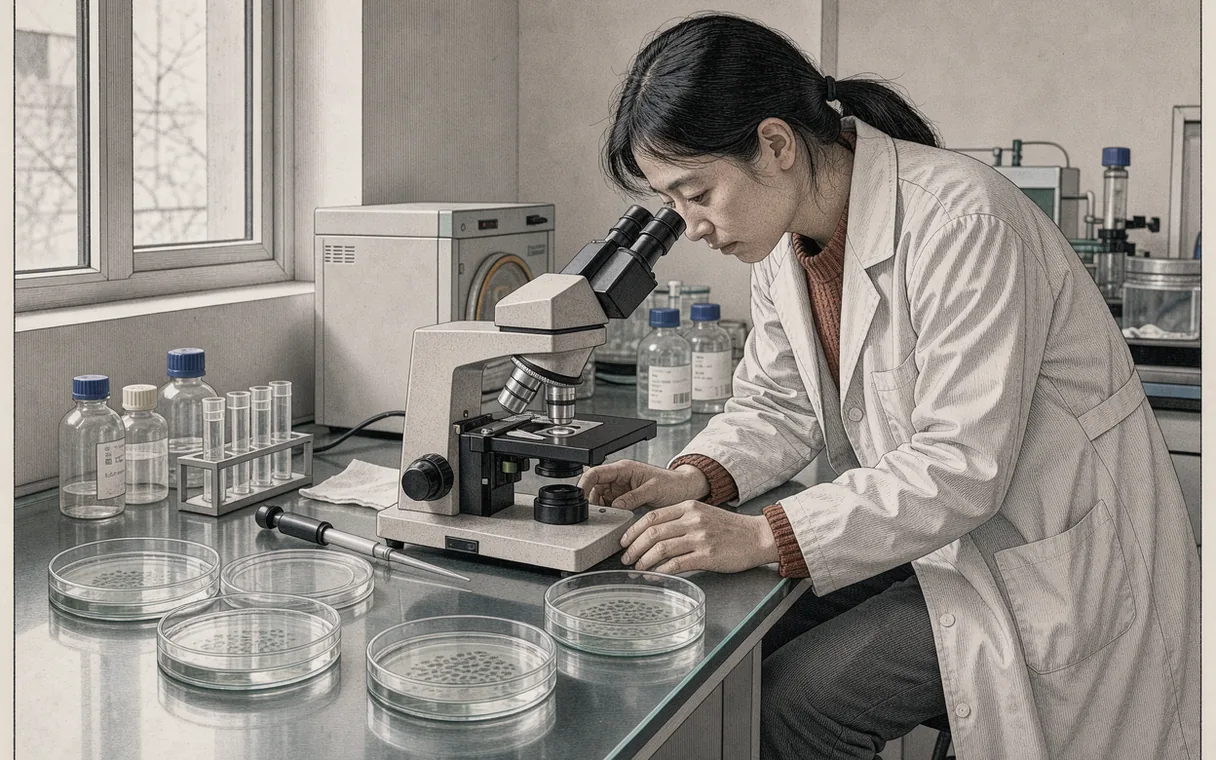
The collagen-synthesis study tested GHK-Cu in human fibroblast cultures. Collagen synthesis increased without a change in cell number. That last observation is easy to lose when the result is reduced to a skin-care claim, yet it is what makes the experiment specific.
I was expecting proliferation to explain the effect: more cells doing the same job. Instead, the reported increase came without a change in cell number. The culture’s output changed. That is a stronger reason to investigate a cellular effect than a vague claim that the peptide “supports” skin.
The setting remains a culture dish. There is no face, wrinkle assessment or report of how someone felt about their skin in this experiment. Its narrowness appeals to me; it makes the next question concrete rather than grand.
The supporting material around cells
The tissue-remodeling review describes increases in the synthesis of collagen, elastin, metalloproteinases and anti-proteases across the work it surveys. These are different pieces of a remodeling account, extending well beyond the amount of collagen produced in a culture.
I favour “turnover” for this picture. It allows for the making and management of tissue material. I struggle with a picture of collagen accumulating in an ever-thicker pile; the review’s mixture of structural proteins, enzymes and anti-proteases suggests a livelier process.
That is an interpretation of the research, with the scope of a review attached. The paper surveys human and animal studies and varied experimental conditions. It is useful for understanding why researchers investigate GHK-Cu in tissue repair, while the culture experiment remains the more tightly specified collagen finding.
From synthesis to visible skin
The skin-regeneration review discusses collagen alongside dermatan sulfate, chondroitin sulfate and decorin synthesis. It also describes topical clinical outcomes including laxity, clarity, fine lines, wrinkle depth and density. The vocabulary changes because the measurements change.
That transition is where my enthusiasm becomes conditional. A metabolic response in a culture is fascinating on its own, and an appearance claim needs observations of appearance. A responsive cell culture can motivate that work without deciding its outcome in advance.
The human skin essay follows the reported topical measurements. The delivery essay examines the barrier between an applied ingredient and the material underneath. Taken together, those questions turn collagen into a more absorbing subject than its skin-care reputation suggests.